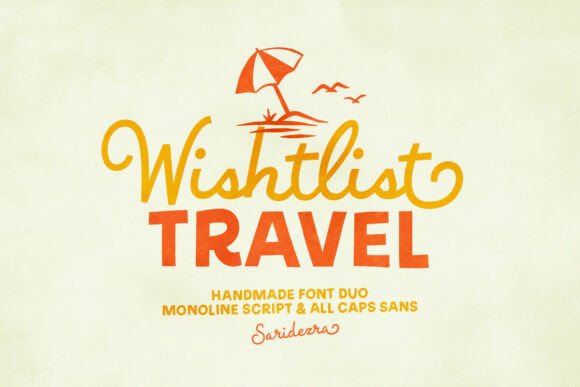
Wishlist Travel: A Handmade Font Duo Built for Impact and Versatility
Choosing the right font is rarely just about aesthetics—it’s about tone, intention, and how well a typeface supports your message across contexts. That’s where Wishlist Travel stands out. It’s not another generic script-sans pairing. It’s a thoughtfully crafted, clean handmade font duo—comprising a fluid monoline script and a confident bold sans—that works as hard as you do.
More Than Just Pretty Letters
At first glance, Wishlist Travel feels effortlessly elegant—like handwriting polished to perfection. But look closer, and you’ll notice the intentional craftsmanship: balanced letterforms, subtle rhythm in the script’s flow, and generous spacing that breathes life into any layout. The monoline script avoids heavy contrast or dramatic flourishes, making it legible at small sizes while retaining warmth and personality. Paired with its bold sans companion, it creates visual harmony—not competition.
This balance is no accident. The script includes ending alternates specifically designed to refine uppercase letters. These subtle variations prevent visual “stacking” or awkward alignment when caps appear at the end of words or lines—especially important in logotypes, quotes, or wedding invitations where every detail is scrutinized. It’s the kind of thoughtful detail that separates professional typography from decorative afterthoughts.
Designed for Real-World Use—Not Just Mockups
Wishlist Travel isn’t built for shelf appeal. It’s engineered for application. Whether you’re designing a holiday card for a boutique brand, laying out a minimalist wedding suite, or crafting a memorable social media quote graphic, this font duo adapts without compromise.
- Wedding Invitations: Its gentle script evokes romance and sincerity, while the bold sans anchors headlines and essential details—RSVP dates, venue names, dress codes—with clarity and authority.
- Holiday Cards & Seasonal Branding: The festive yet refined character makes it ideal for limited-edition packaging, gift tags, or email headers—where warmth and distinction matter more than trend-chasing.
- Logotypes & Brand Identity: Because the script and sans share proportional DNA, they integrate seamlessly into logos—even when used independently. You can build a full identity system without switching fonts mid-design.
- Digital Quotes & Social Content: Clean line weight and strong x-height ensure readability on screens—from Instagram carousels to Pinterest pins—even without heavy shadow or outline effects.
And because Wishlist Travel supports multilingual characters, designers working with diverse audiences—whether creating bilingual wedding stationery, global product packaging, or inclusive marketing campaigns—won’t hit language barriers mid-project. Extended Latin, Cyrillic, and common diacritics are included, reducing last-minute font swaps or compromised layouts.
Why “Handmade” Matters in a Digital Age
In an era saturated with AI-generated assets and algorithmically optimized templates, there’s renewed appreciation for human touch—and Wishlist Travel delivers that authenticity without sacrificing polish. The script doesn’t mimic calligraphy tools; instead, it captures the ease and variation of skilled hand-drawing. You’ll notice slight irregularities in stroke entry and exit—just enough to feel alive, never distracting.
This isn’t nostalgia for nostalgia’s sake. It’s strategic. Human-made imperfection builds trust. Studies show users subconsciously associate organic line work with care, craft, and intentionality—qualities that resonate deeply in premium markets like luxury weddings, artisan goods, or boutique hospitality.
Importantly, Wishlist Travel avoids the pitfalls of overly ornate scripts: no tangled loops, no fragile terminals, no need for manual kerning adjustments on every word. It’s handmade—but production-ready.
Fitting Into Modern Design Workflows
Designers juggling tight deadlines and cross-platform deliverables need reliability. Wishlist Travel integrates smoothly into everyday tools: Adobe Creative Cloud (Illustrator, Photoshop, InDesign), Figma, Canva (via upload), and even modern web projects using @font-face or variable font-friendly hosting.
Its OpenType features—including ligatures, stylistic alternates, and contextual substitutions—are accessible through standard font menus. No plugins required. For example, enabling ending alternates in Illustrator takes two clicks—yet instantly refines the visual weight of titles like “Mr. & Mrs. Thompson” or “Joyeux Noël.”
For developers embedding Wishlist Travel into websites or apps, the clean vector outlines render crisply at any size—no pixelation, no fuzzy edges. And because both script and sans share consistent metrics (cap height, x-height, baseline alignment), responsive layouts stay cohesive whether viewed on mobile or desktop.
What Designers Actually Consider Before Choosing
Before committing to a font like Wishlist Travel, professionals weigh more than style. Here’s what often guides the decision:
- Licensing Clarity: Does the license cover web use, app embedding, and commercial print runs? Wishlist Travel offers straightforward licensing tiers—including options for unlimited projects—so there’s no guesswork when scaling client work.
- File Organization: Are OTF, WOFF2, and desktop versions clearly labeled and easy to locate? Yes—each weight and style is logically named and grouped, saving time during asset handoff.
- Support & Updates: Is the creator responsive? Do updates include expanded language support or new alternates? Wishlist Travel’s development history shows iterative improvements based on real user feedback—not just seasonal releases.
- Pairing Flexibility: Can the script stand alone—or does it demand the sans? Wishlist Travel’s script holds up beautifully solo (think engraved foil-stamped menus), but its true strength shines in tandem—making it adaptable across phases of a project’s lifecycle.
When Wishlist Travel Might Not Be the Right Fit
Honesty matters. While Wishlist Travel excels in expressive, human-centered design, it’s not meant for every scenario. If your project requires extreme technical precision—like scientific labeling, regulatory documentation, or UI interface text requiring WCAG AA+ contrast compliance—the bold sans may lack the fine-tuned legibility of dedicated UI fonts at tiny sizes.
Similarly, if your brand voice leans heavily into industrial, tech-forward, or ultra-minimalist territory (think monospace systems or stark geometric sans-serifs), Wishlist Travel’s warmth might soften the edge you’re aiming for. That’s not a flaw—it’s fidelity to its purpose.
A Font That Grows With Your Projects
One underrated strength of Wishlist Travel is its scalability across creative roles. A freelance designer can use it for a single client’s holiday campaign. A studio art director might build an entire brand language around it—extending into custom icons, pattern overlays, or motion graphics using the same rhythmic cadence.
Even non-designers benefit. Small business owners using Canva or Squarespace can upload Wishlist Travel to elevate newsletters, product labels, or Etsy shop banners—without needing advanced typography knowledge. The intuitive pairing does much of the work.
Over time, many users report that Wishlist Travel becomes a “go-to anchor”—not because it’s safe, but because it’s consistently reliable, emotionally resonant, and technically sound. It doesn’t shout. It connects.
Final Thought: Typography as Quiet Confidence
In a world of fleeting trends and attention-grabbing gimmicks, Wishlist Travel represents something quieter but more enduring: confidence rooted in craft. It doesn’t try to be everything. It does a few things exceptionally well—and does them across languages, platforms, and purposes.
That’s why it shows up on wedding suites that get framed, on café menus that spark Instagram stories, and in brand identities that feel personal without being precious. Wishlist Travel doesn’t just sit on the page. It invites people in.